

Four years ago, on August 16, 2022, Greensboro City Council voted unanimously to award an incentive of over half a million dollars to an out-of-state company called ImpactData. The money was for a proposed nine-megawatt data center on the campus of North Carolina Agricultural and Technical State University, and the promise of 28 jobs.
The infrastructure was not vetted. The company had existed less than two years. Yet, due to the advocacy of some especially interested parties, Council voted 9–0 to allocate the public funds.
One of the most strident advocates for the so-called “Dream Center,” initially known as “Project Hawk,” was the organization Gateway Research Park, which describes itself as “a catalyst for university research, innovation, and economic development.” In a letter of support for the project, then-executive director Jim Westmoreland stated that the data center “received unanimous project support and endorsement from our Board of Directors [as] of February 1, 2022.” This appears to have occurred within a month of current Mayor Pro Tem Denise Roth joining Gateway Research Park’s board, on which she still sits, in addition to her roles with the AI Trust Foundation; CEG Solutions LLC, which develops infrastructure strategies for data centers; and Commonweal Ventures, which boasts the surveillance corporation Palantir among its clients. In an attempt “to protect the integrity of the process and public confidence in the decisions Council ultimately makes”—while maintaining that “I do not have an actual or direct conflict of interest”—Roth moved on August 17 to publicly recuse herself from future votes relating to data centers.
In his 2022 letter, Westmoreland said Gateway Research Park supported ImpactData’s project “based on our review of their qualifications, development experience, and planned financing.” The details of their supposed qualifications, experience, and financing remained unspecified.
Marshall Yandle, the city’s Economic Development Manager, also advocated for the project, speaking at the August 16, 2022 council meeting and leaving helpful advisory comments on ImpactData’s proposal, as revealed in documents received through a public records request.
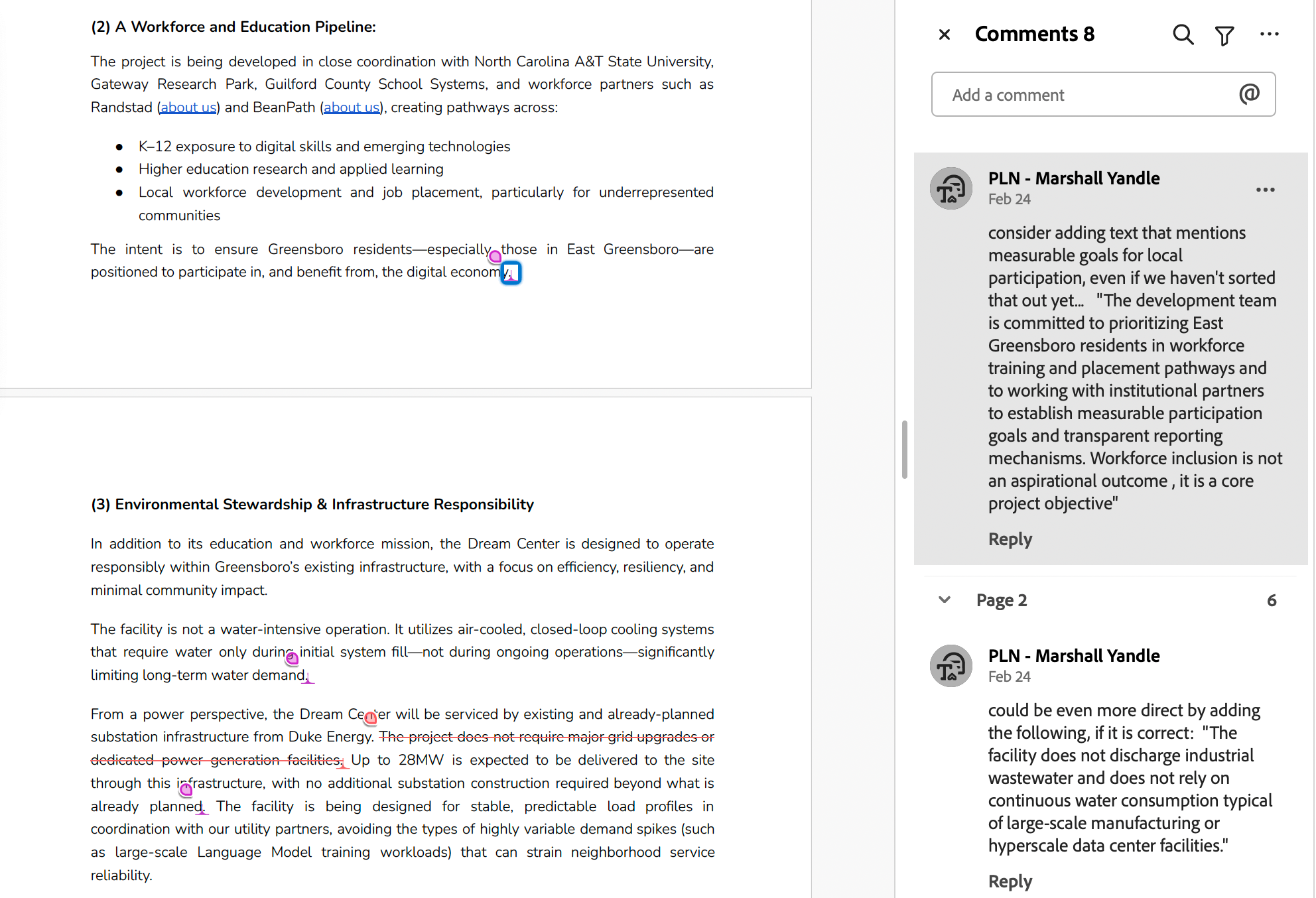
Executive Vice President of the Greensboro Chamber of Commerce Marvin Price pushed for approval of the incentive funds as well, telling council members, “Truly, we would love it if you guys were to vote in the affirmative.”
DREAM OR DELUSION?
In the April 2022 project summary form, ImpactData disclosed they had only two full-time employees. They provided lofty descriptions of their plans, stating, “We hope that the Dream Center will provide a marvel in design, sustainability, human capital empowerment and economic development.” They said they would begin capital investments in January 2023, with operations to commence in April 2024. By the end of 2026, they promised to hire all of the 28 employees for which the city intended to reward them. The company attested they had the financial capacity for the project, stated they will own the project facility, and named six other cities—including Atlanta, Dallas, and Miami—they were considering for this project. They called the selection process “highly competitive.”
CEO Terry Comer describes ImpactData as “on a mission to build out $1+ Billion in digital infrastructure alongside Historically Black Colleges & Universities (HBCUs), the largest technology investment in the history of Higher Education.” Co-founder and COO David Calloway says “ImpactData is one of the largest boutique data center and infrastructure developers in the Southeast.”
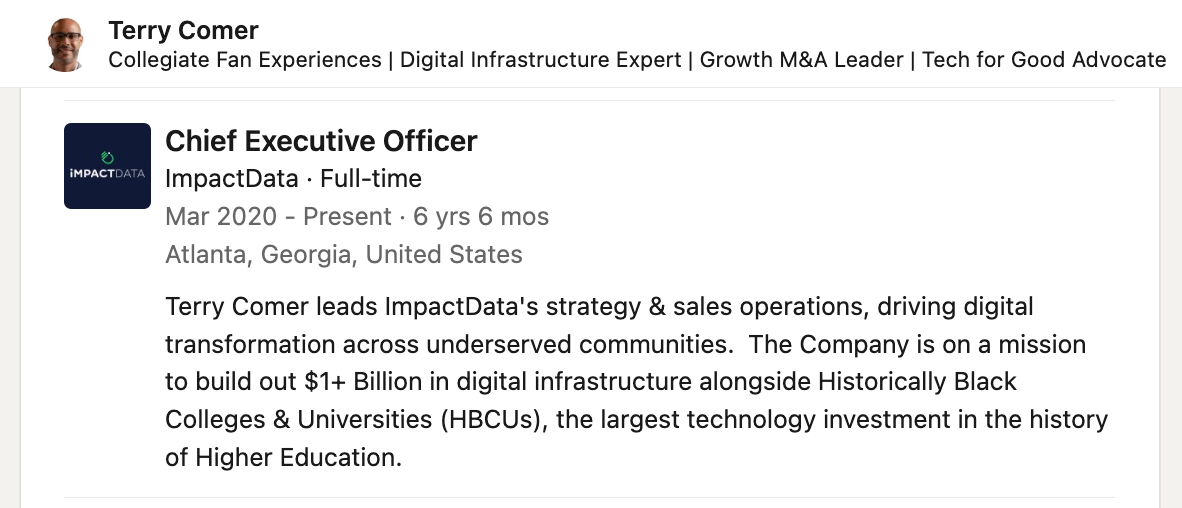
These are lofty words for any enterprise. They are even more noteworthy in light of the fact that ImpactData has, to date, built precisely zero data centers. In fact, they only have a single data center in the works—the one Greensboro City Council approved and incentivized. And what has the company to show for this vote of confidence?
Four years after the council’s approval of the incentive, ImpactData has yet to break ground on the project site, located at 2901 East Gate City Boulevard. Two years after operations were supposed to commence, the company still has made no capital investments, much less created any jobs.
According to City Council’s August 2022 resolution, “The incentive will expire if the new jobs are not created and the investment is not made by December 31, 2026.” That date is currently four months away. Even relatively small data centers typically take upwards of a year to construct. Now that the “Dream Center” has apparently expanded from nine to 20 megawatts, allegedly scalable to 300 megawatts, this timeline appears even more farcical.
WHAT IMPACT?
All of this was entirely predictable. Behind the laudatory rhetoric, council’s advisors and council members themselves failed to conduct basic due diligence on the company they giddily awarded half a million of residents’ tax dollars.
Based exclusively on publicly available data, a look at the company’s leadership raises immediate questions.
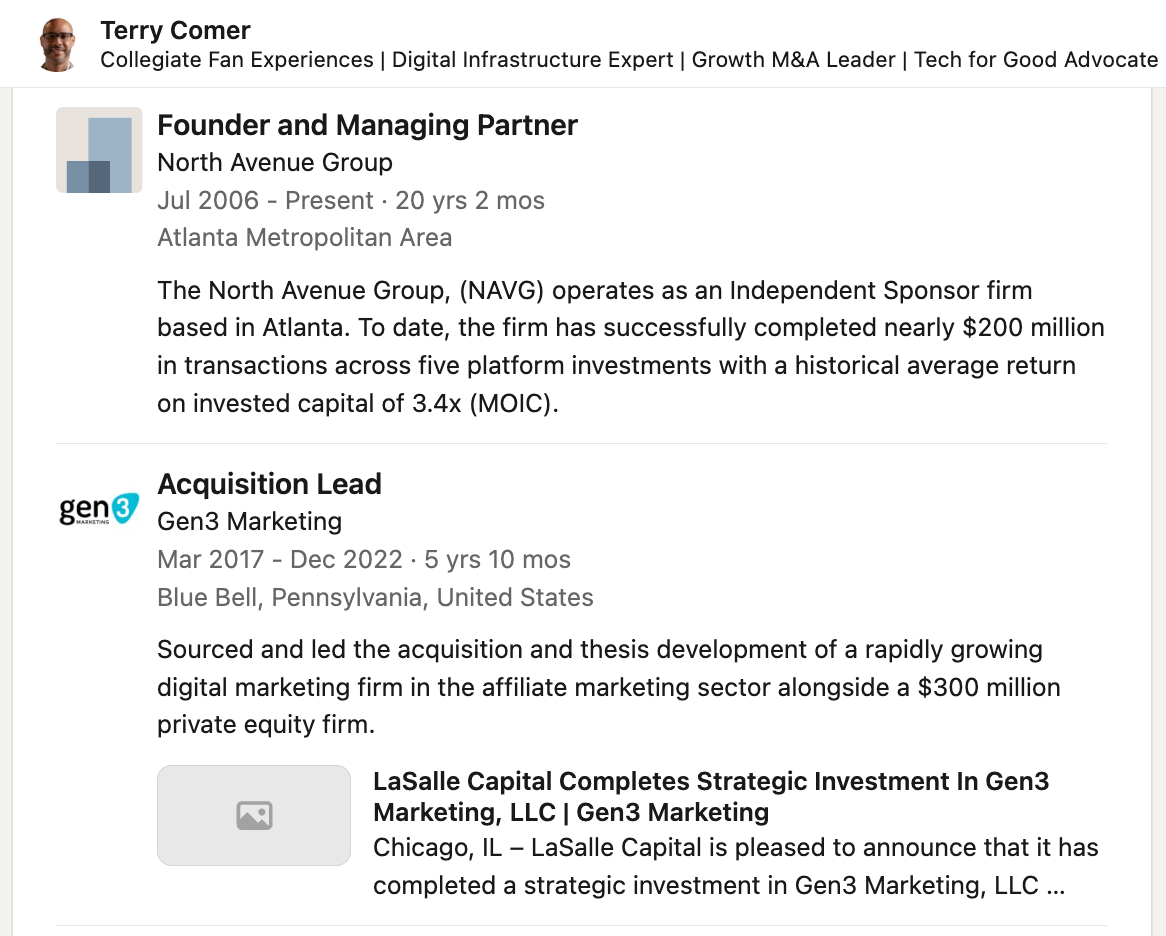
ImpactData CEO Terry Comer has a fairly well-documented record, with a clear trajectory. The direction is not encouraging. He says he earned bachelor’s degrees in mathematics and engineering from Morris Brown College and Georgia Institute of Technology, respectively. Then he lists an MBA from Harvard Business School as secured in 2006. Upon graduating, he “launched a career into the world of private equity,” fancying himself a “buyout entrepreneur.” He started the private equity firm North Avenue Group, where he purports to maintain the position of “Founder and Managing Partner” to this day, though he is not currently named on the firm’s website.
In 2007, Comer joined American Biosurgical LLC, taking the titles Director of the Board, President, and Chief Operating Officer. There, he seemed to race the company’s CEO in a tireless quest to improve the struggling medical equipment manufacturer.


In 2013, the American Biosurgical’s board brought in ACM Capital Partners to address “severe financial distress” due to “high-cost mezzanine debt.” That same year, Comer left American Biosurgical. He reports a month spent in acquisition work with Majority Strategies, a large political mailing company. Between 2012 and 2017, he worked on acquiring a corporate gym and a trucking company.
In 2017, some clearer inklings emerge with regard to how Comer operated as a “buyout entrepreneur.” His resume lists his role as “Acquisition Lead” for Gen3 Marketing, from March 2017 to December 2022. But according to a lawsuit filed in 2018 and decided in 2022, Gen3’s Co-CEOs Michael Tabasso and Andrew Cantos firmly rejected Comer’s involvement in the acquisition of their company, finding Comer unreliable and unprofessional after months of unfulfilled promises:
“In his deposition, Tabasso said that when [investment banking firm] Sett & Lucas contacted him saying LaSalle wanted to meet he and Cantos said that if Comer was attached to the proposed deal they did not want to take the meeting, and they only agreed to meet with LaSalle once they learned that Comer would not be involved.
“Tabasso and Cantos stated in no uncertain terms that they would not have done a deal with Comer and [Comer’s business partner AJ] Igherighe even if the latter two men had come up with the capital to buy the company. By way of example, at one point during his deposition Tabasso stated, ‘Andy and I had such a crisis of confidence, we had decided that these folks were not who they had presented themselves to be. Certainly Mr. Comer had presented himself to be a professional and sharp and put-together guy. And he was neither professional, nor sharp, nor put together. And AJ was just a fool. And the idea of spending the next five years with those two guys was so distasteful that I said to Andy at one point around this time, I don’t care if he backs a Brinks truck up to my house and dumps the money on the front porch, I don’t want to work with him.’
“Cantos went as far as to say at his deposition that he was willing to walk away from $25 million to not work with Comer and Igherighe: ‘Trust me, trust me, I will say factually and faithfully and honestly I did not want to sell my business to them. I was willing to walk away from $25 million, there about, for the right not to work with this individual.’”
Whatever weight one affords the opinions of two individual capitalists, these statements were made under oath. Comer clearly attempted to lead the acquisition of the marketing agency, but the claim he was substantively involved—much less the “Acquisition Lead”—strains credulity.
IDLE DATA
While the Gen3 lawsuit made its way in the courts, Comer founded the venture ImpactData, alongside co-founder David Calloway. Comer lists the founding date as March 2020; Calloway, as August 2019. The Georgia-based LLC notes an incorporation date of March 2020.
Comer says he tapped Calloway for the latter’s experience in real estate. Together, they came up with a plan “to position data centers on the campuses of historically Black colleges.“ Calloway also came with a background in law and private equity, and a connection to the investment firm Digital Bridge via his role there as a contracted “Entrepreneur in Residence” from 2021 to 2023.
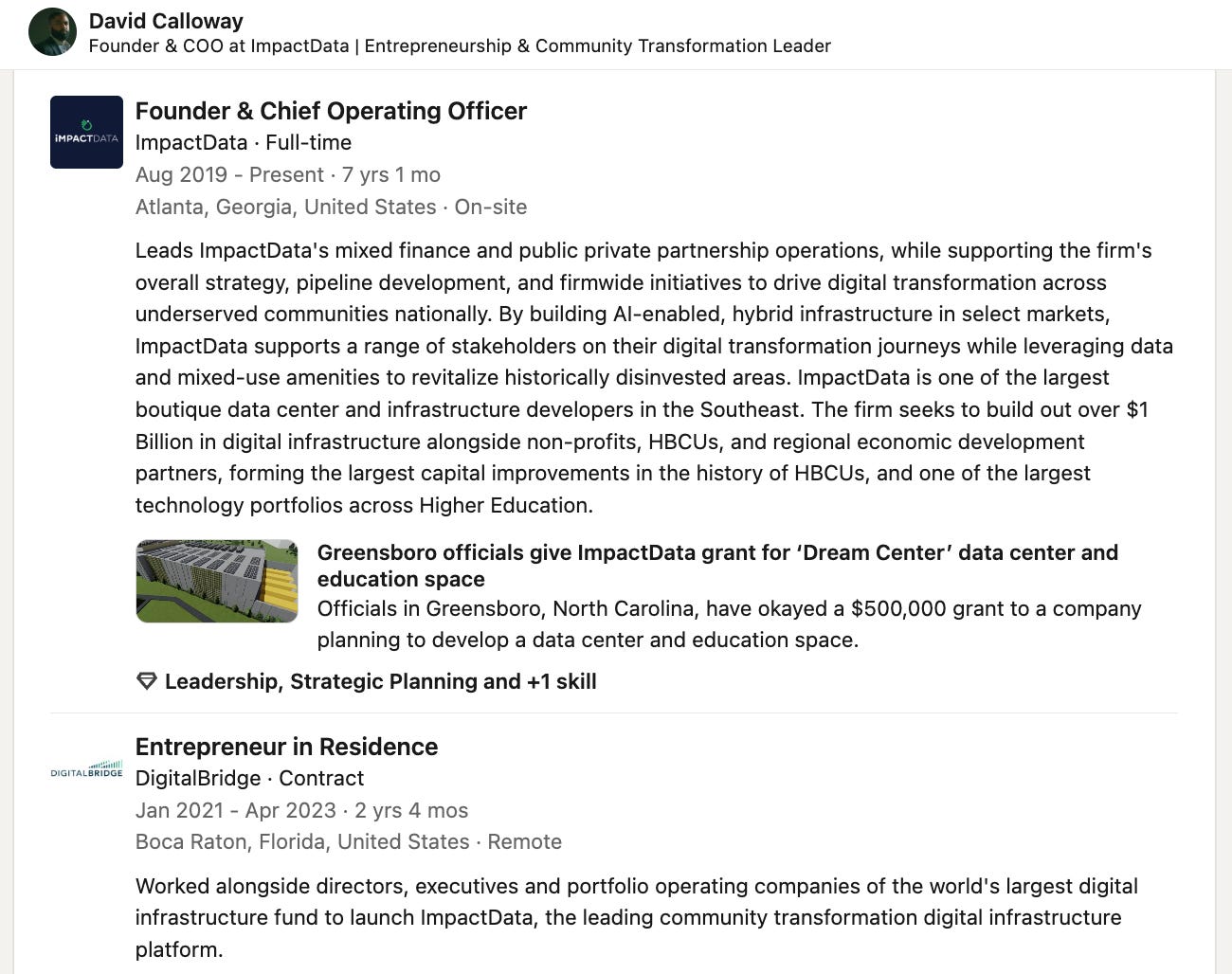
In September 2021, Digital Bridge announced a partnership with ImpactData to develop data center infrastructure “in underserved communities.” At that time, it seems Greensboro was not on the company’s radar, or at least not high on its list: “ImpactData is currently exploring several attractive markets, including Atlanta, Dallas, Houston, Nashville, Birmingham, and Charlotte, to pilot its cloud center model.”
According to ImpactData’s project summary form, a partnership with Digital Bridge would facilitate the development of the Greensboro data center at A&T. In December 2025, Digital Bridge entered into an agreement to be acquired by SoftBank Group, for approximately $4 billion. Upon consummation of the agreement, Digital Bridge will become an indirect subsidiary of SoftBank. It is unclear what effect this will have on ImpactData’s relationship with the investment firm, and its access to the $108.5 million in funds promised for developing the proposed data center.
As of May 2025, the business license for ImpactData’s North Carolina LLC was revoked, meaning it cannot operate. The company maintains a Georgia-based LLC under a similar name. The city’s contract for the data center lists another company name entirely: “Dream Center GSO1, LLC.” There are at least two active corporations under that name, one in North Carolina and one in Delaware. The former was incorporated on 28 July 2022—less than one month before Greensboro City Council approved the $530,359.00 incentive.
CONTINUING QUESTIONS
At least one member of the current Greensboro City Council has recognized the non-viability of ImpactData’s project. During the August 17 public hearing on the city’s proposed data center moratorium, District 1 Councillor Crystal Black raised questions about the site plan that the prior council approved for funding.
City Attorney Lora Cubbage responded that there is currently no approved site plan on file for the A&T data center, as the prior plan expired in July 2025. ImpactData has yet to provide an updated site plan. A site plan must be on file for a project to move forward. In order for the ImpactData project to proceed, the company will need to submit a new site plan, which must proceed through the original approval process.
Following up on her question to Water Resources Director Michael Borchers at council’s July 22, 2026 work session, Councillor Black asked whether a water feasibility study had been conducted on this project at any point in time. Cubbage relayed an email from Borchers, stating that there had been a feasibility study—conducted twenty years ago, in 2001. This study was for “an extension within the research park at 2901 Gate City Blvd” and was, as Cubbage perspicaciously noted, not for the ImpactData project.
To the question of whether the project site was properly zoned to accommodate a data center, Cubbage noted that if a project is “data center-focused, it cannot go there unless that land is re-zoned, because it is zoned for public and institutions”—as we have previously reported.
Councillor Black also extracted some information from the city attorney on who, exactly, approved the ImpactData center. While the city approved the incentive money, Cubbage said she believed that the Gateway Research Park board approved the actual project.
Regarding the deadline for the project to receive city incentive funds, Cubbage acknowledged, “the only involvement the city has is the incentives, which in the economic development agreement with the developers, there are benchmarks that must be met. And the resolution that the prior city council approved was based on this investment taking place by December 31, 2026.”